A Truth Universally Acknowledged: 33 Great Writers on Why We Read Jane Austen
Review by Arti of Ripple Effects
The first challenge you face when writing about Pride and Prejudice is to go through your offset sentences without proverb, "it is a truth universally best-selling…" —– Martin Amis

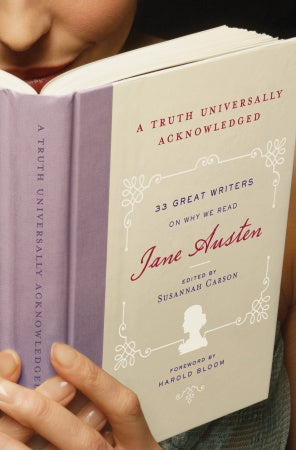 Isn't it true that these words from the clever and satirical opening line of Jane Austen's Pride and Prejudice take been and then overused that they have sadly become a cliché in our contemporary language, together with 'zombies' and 'vampires'. And so what did I look from a book entitled A Truth Universally Acknowledged: 33 Great Writers on Why We Read Jane Austen? (Purchase online at our giftshop!) I acknowledge, at offset I idea it was a literary version of those lifetime achievement award presentations, where the honoree is showered with superfluous speeches by his/her peers, over champagne and frivolous dinner, something which Jane Austen herself would abhor. I constitute out soon enough that between the modest and archetype looking covers, Susannah Carson, the editor of the volume, had gathered the essays of 33 writers, not toasts or roasts, but detailed biographical notes, thoughtful musings, heartfelt adoration and in-depth analysis of Austen characters and works. Information technology is a collection of articles stemming from a counterbalanced fusion of sense and sensibility, something that Austen herself would take canonical. Included are literary figures from the late 19th to 20th centuries like E. One thousand. Forster, Due west. Somerset Maugham, C. S. Lewis, Eudora Welty and Virginia Woolf. Contemporary contributors include writers, academics, Austen historian, and screenwriters. There are views from Harold Flower, Lionel Trilling, Janet Todd, Anna Quindlen, A. South. Byatt, Amy Blossom, to name a few. All of them point to Austen'south inimitable humor, incisive observations of human nature and unwavering moral stance that brand her works nevertheless relevant two hundred years after today. The following are some samples from this smorgasboard of Austen delights. Harold Bloom, writing the preface, concludes with these lines:
"Nosotros read Austen because she seems to know the states better than we know ourselves, and she seems to know the states so intimately for the simple reason that she helped determine who we are both as readers and as homo beings."
Anna Quindlen, defending the discipline matter in Austen'south works being mainly near the family (information technology'southward a pity that she even needs to practice this):
"…[Austen was] a author who believed the disharmonism of personalities was as meaningful every bit—perhaps more meaningful than—the clash of sabers. For those of us who suspect that all the mysteries of life are contained in the microcosm of the family, that personal relationships prefigure all else, the piece of work of Jane Austen is the Rosetta stone of literature."
Austen once referred her own writing every bit "the little bit (two inches wide) of ivory on which I work with so fine a brush, equally produces little effect later on much labour." Screenwriter and director Amy Heckerling, who has adjusted Emma into the motion-picture show 'Clueless', compares Austen'southward writing to a Vermeer painting:
"Sometimes the finest brushes paint the biggest truths."
James Collins, a author and editor, and frequent contributor to The New Yorker, shares a very personal view:
"I find that reading Jane Austen helps me clarify ethical choices, helps me figure out a way to alive with integrity in the corrupt world, fifty-fifty helps me prefer the proper tone and style in dealing with others… Reading Austen I sometimes feel as if my morals are a wobbly figurine that her hand reaches out and steadies."
But she is not all didactic and stern… far from information technology. Jane Austen has long been celebrated for her animated humour and witty ironies, the essence of her writing. I love this analogy that Collins uses:
Her ironies swirl and drop like the cast of a fly fisherman. This rhythmic movement seems to me ideal for both accepting and rejecting the ways of the wretched world while maintaining balance.
Demonstrating the relevance of her satires for today, Benjamin Nugent, the author of American Nerd: The Story of My People, discusses the nerds in Pride and Prejudice, Mary Bennett and Mr. Collins, and why they miss out on life.
"If y'all read sci-fi novels, you'll generally read almost worlds in which scientists and the technologies they create bulldoze the plot; if y'all read Austen, you'll read about a world in which technology means nothing and the triumphs and failures of conversational agility bulldoze everything."
His advice for mod twenty-four hours nerds:
"Young nerds should read Austen because she'll force them to hear dissonant notes in their own speech they might otherwise miss, and open up their optics to defeats and victories they otherwise wouldn't even have noticed. Like near all worthwhile adolescent experience, it tin can be depressing, only information technology tin as well experience like waking upwards."
It takes a sharp ear and intelligence to be a adept humorist, and Austen shows that she has what it takes to be 1 at an early on age. About her prodigious talent, Virginia Woolf praises her starting time work, the novella Dear and Friendship, written when Austen was merely 15:
"an astonishing and unchildish story… Spirited, easy, total of fun, verging with freedom upon sheer nonsense–Love and Friendship is all that… The girl of fifteen is laughing, in her corner, at the globe."
Indeed, equally editor Susannah Carson has stated, any hint of 'romance' in her novels is merely the irony of information technology. Near the seemingly unconvincing romantic plot in Northanger Abbey, Carson asserts:
"What if Austen actually intended the romance plot to be unconvincing? … It is probable… that Austen intended the failure of the romance plot, non to sabotage her own work, simply to brand a point about romance plots in full general… that [they] are inherently artificial."
That Northanger Abbey is a satire on the gothic novel has long been noted. Other writers also stress that Austen should not be labelled as a 'romance author' considering of the satirical styling behind her writing. W. Somerset Maugham keenly observes: "She had too much mutual sense and too sprightly a humor to be romantic." In his essay 'Beautiful Mind', writer Jay McInerney bravely admits that: "If my actual romantic life has sometimes been influenced by superficial considerations, as an Austen reader the ground of my affections has been almost entirely cognitive. Amy Bloom sums it upwards succinctly about this mutual confusion near romance and dearest:
"Jane Austen is, for me, the best author for anyone who believes in beloved more than than in romance, and who cares more for the individual than the public. She understands that men and women have to grow upwards in order to deserve and achieve great love, that some suffering is necessary (that mewling near it in your memoir or on a talk show will not help at all), and that people who mistake the desirable object for the one necessary and essential honey will become what they deserve."
To primary such a stardom could well be one of the main reasons why nosotros read Jane Austen. Listing Price: $25.00 Hardcover: 320 pages Publisher: Random House; i edition (x Nov 2009) ISBN-x: 1400068053 ISBN-xiii: 978-1400068050
 Arti reviews movies, books, arts and entertainment on her blog Ripple Effects. She has pleasure in many things, in particular, the work and wit of Jane Austen.
Source: https://janeausten.co.uk/blogs/media-reviews/why-we-read-jane-austen-2

Enregistrer un commentaire for "A Truth Universally Acknowledged: 33 Great Writers on Why We Read Jane Austen"