Castle Story Make Archers Into Workers Again
| Himeji Castle 姫路城 | |
|---|---|
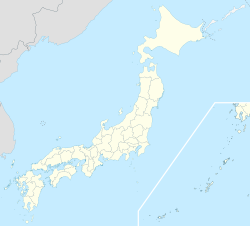
| Himeji, Hyōgo, Nippon | |
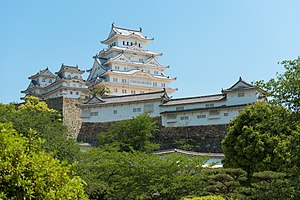 Himeji Castle in May 2015 after the 5-year renovation of the roof and walls | |
| Himeji Castle | |
| Coordinates | 34°50′22″North 134°41′38″Due east / 34.83944°N 134.69389°East / 34.83944; 134.69389 Coordinates: 34°50′22″N 134°41′38″E / 34.83944°N 134.69389°Due east / 34.83944; 134.69389 |
| Blazon | Azuchi-Momoyama castle[1] |
| Peak | 46.4 yard (152 ft) |
| Site data | |
| Condition | Intact, restoration piece of work for preservation recently completed[2] |
| Site history | |
| Built |
|
| Built by |
|
| In utilise | 1333–1868[3] [half-dozen]-1945(as armed forces camp) |
| Materials | Wood, stone, plaster, tile[5] |
| Demolished |
|
| Garrison information | |
| Garrison |
|
| UNESCO World Heritage Site | |
| Official name | Himeji-jo |
| Criteria | Cultural: i, iv |
| Reference | 661 |
| Inscription | 1993 (17th Session) |
| Surface area | 107 ha |
| Buffer zone | 143 ha |

| Himeji Castle | |||||
|---|---|---|---|---|---|
 "Himeji Castle" in kanji | |||||
| Japanese name | |||||
| Kanji | 姫路城 | ||||
| |||||
Himeji Castle ( 姫路城 , Himeji-jō ) is a hilltop Japanese castle complex situated in the urban center of Himeji which is located in the Hyōgo Prefecture of Nihon. The castle is regarded as the finest surviving example of prototypical Japanese castle architecture, comprising a network of 83 rooms with avant-garde defensive systems from the feudal period.[seven] The castle is frequently known every bit Hakuro-jō or Shirasagi-jō ("White Egret Castle" or "White Heron Castle") considering of its brilliant white outside and supposed resemblance to a bird taking flight.[6] [viii]
Himeji Castle dates to 1333, when Akamatsu Norimura congenital a fort on meridian of Himeyama loma. The fort was dismantled and rebuilt as Himeyama Castle in 1346, and and then remodeled into Himeji Castle two centuries later. Himeji Castle was so significantly remodeled in 1581 by Toyotomi Hideyoshi, who added a three-story castle proceed. In 1600, Tokugawa Ieyasu awarded the castle to Ikeda Terumasa for his help in the Battle of Sekigahara, and Ikeda completely rebuilt the castle from 1601 to 1609, expanding it into a large castle circuitous.[3] Several buildings were later added to the castle circuitous by Honda Tadamasa from 1617 to 1618.[5] For almost 700 years, Himeji Castle has remained intact, even throughout the bombing of Himeji in World War II, and natural disasters including the 1995 Bully Hanshin convulsion.[iii] [two] [nine]
Himeji Castle is the largest and virtually visited castle in Japan, and information technology was registered in 1993 as one of the first UNESCO World Heritage Sites in the country.[ii] The surface area within the middle moat of the castle complex is a designated Special Celebrated Site and five structures of the castle are also designated National Treasures.[five] [10] Along with Matsumoto Castle and Kumamoto Castle, Himeji Castle is considered i of Japan's three premier castles.[eleven] In society to preserve the castle buildings, it underwent restoration work for several years and reopened to the public on March 27, 2015.[12] The works too removed decades of dirt and grime, restoring the formerly grey roof to its original brilliant white color.
History [edit]
Himeji Castle's construction dates to 1333, when a fort was synthetic on Himeyama hill by Akamatsu Norimura, the ruler of the aboriginal Harima Province.[3] In 1346, his son Sadanori demolished this fort and built Himeyama Castle in its place.[3] [13] In 1545, the Kuroda clan was stationed here by social club of the Kodera association, and feudal ruler Kuroda Shigetaka remodeled the castle into Himeji Castle, completing the work in 1561.[3] [xiv] In 1580, Kuroda Yoshitaka presented the castle to Toyotomi Hideyoshi, and in 1581 Hideyoshi significantly remodeled the castle, building a three-story keep with an area of about 55 k2 (590 sq ft).[5] [14]
Following the Battle of Sekigahara in 1600, Tokugawa Ieyasu granted Himeji Castle to his son-in-police force, Ikeda Terumasa, as a reward for his help in battle.[iii] Ikeda demolished the three-story keep that had been created past Hideyoshi, and completely rebuilt and expanded the castle from 1601 to 1609, adding iii moats and transforming it into the castle circuitous that is seen today.[3] [five] The expenditure of labor involved in this expansion is believed to have totaled 2.5 one thousand thousand human being-days.[iii] Ikeda died in 1613, passing the castle to his son, who also died three years later on.[iv] In 1617, Honda Tadamasa and his family inherited the castle, and Honda added several buildings to the castle complex, including a special tower for his girl-in-law, Princess Sen ( 千姫 , Senhime ) [4] chosen keshō yagura (Dressing Tower).
In the Meiji Catamenia (1868–1912), many Japanese castles were destroyed.[2] Himeji Castle was abandoned in 1871 and some of the castle corridors and gates were destroyed to make room for Japanese ground forces barracks.[5] [14] The entirety of the castle complex was slated to be demolished by government policy, simply information technology was spared past the efforts of Nakamura Shigeto, an regular army colonel.[5] A stone monument honoring Nakamura was placed in the castle complex within the first gate, the Hishi Gate ( 菱の門 , Hishinomon ).[v] [15] Although Himeji Castle was spared, Japanese castles had become obsolete and their preservation was plush.[5]

Forepart view of the castle circuitous
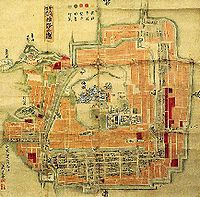
A 1761 depiction of the castle complex
When the han feudal system was abolished in 1871, Himeji Castle was put up for auction.[5] The castle was purchased past a Himeji resident for 23 Japanese yen (about 200,000 yen or US$2,258 today).[5] The heir-apparent wanted to annihilate the castle complex and develop the country, but the toll of destroying the castle was estimated to be too cracking, and it was again spared.[five]
Himeji was heavily bombed in 1945, at the end of World War Ii, and although most of the surrounding expanse was burned to the ground, the castle survived intact.[seven] One firebomb was dropped on the top flooring of the castle but failed to explode.[sixteen] In order to preserve the castle complex, substantial repair work was undertaken starting in 1956, with a labor expenditure of 250,000 human-days and a cost of 550 million yen.[v] [xiv] In Jan 1995, the city of Himeji was substantially damaged past the Great Hanshin earthquake, simply Himeji Castle once more survived virtually undamaged, demonstrating remarkable earthquake resistance.[nine] Even the bottle of sake placed on the altar at the elevation floor of the keep remained in place.[9]

The "Three Country Moat" in the centre of the castle complex
Historical recognition [edit]
Himeji Castle was registered on eleven December 1993 as 1 of the first UNESCO World Heritage Sites in Japan.[5] [2] [7] Five structures of the castle are as well designated National Treasures: The principal go on ( 大天守 , daitenshu ),[17] [eighteen] northwest small-scale keep ( 乾小天守 , inui kotenshu ),[19] west small-scale proceed ( 西小天守 , nishi kotenshu ),[20] east small continue ( 東小天守 , higashi kotenshu ),[21] and I, Ro, Ha, Ni-corridors and kitchen ( イ, ロ, ハ, ニの渡櫓附台所1棟 , i, ro, ha, ni no watariyagura tsuketari daidokoro i to ).[ten] [22] The area within the eye moat of the castle complex is a designated Special Historic Site.[5]
Forth with Matsumoto Castle and Kumamoto Castle, Himeji Castle is considered one of Japan's iii premier castles.[11] It is the well-nigh visited castle in Nihon, receiving over 2,860,000 visitors in 2015.[3] [two] Starting in Apr 2010, Himeji Castle underwent restoration work to preserve the castle buildings, and reopened to the public on March 27, 2015.[12]
Design details [edit]
Himeji Castle is the largest castle in Nihon.[2] Information technology serves every bit an excellent example of prototypical Japanese castle compages, containing many of the defensive and architectural features associated with Japanese castles.[7] The curved walls of Himeji Castle are sometimes said to resemble giant fans ( 扇子 , sensu ), but the principal materials used in the structures are stone and wood.[5] [6] Feudal family crests ( 家紋 , kamon ) are installed throughout the compages of the edifice, signifying the various lords that inhabited the castle throughout its history.[5]
The specific style of the castle is a hirayama (平山城 apartment hilltop). Ii castles that were built during the same time and shared many of the architectural features are Matsuyama Castle (Iyo) and Tsuyama Castle.

A depiction of the intricate castle complex

The Himeji Castle complex is located in the center of Himeji, Hyōgo on top of a hill chosen Himeyama, which is 45.6 m (150 ft) above sea level. The castle complex comprises a network of 83 buildings such every bit storehouses, gates, corridors, and turrets ( 櫓 , yagura ).[v] [xv] Of these 83 buildings, 74 are designated as Important Cultural Assets: 11 corridors, xvi turrets, fifteen gates, and 32 earthen walls.[9] The highest walls in the castle complex have a height of 26 yard (85 ft).[5] Joining the castle complex is Kōko-en ( 好古園 ), a Japanese garden created in 1992 to commemorate Himeji city's 100th anniversary.[23]
From east to w, the Himeji Castle circuitous has a length of 950 to ane,600 m (three,120 to 5,250 ft), and from north to south, information technology has a length of 900 to 1,700 thou (3,000 to five,600 ft).[v] The castle complex has a circumference of 4,200 m (2.6 mi).[5] It covers an area of 233 hectares (2,330,000 m2 or 576 acres), making it roughly 50 times every bit large as the Tokyo Dome or lx times as large as Koshien Stadium.[three] [five] [7]
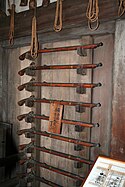
Weapon racks inside the keep
The main keep ( 大天守 , daitenshu ) at the centre of the complex is 46.four m (152 ft) high, continuing 92 one thousand (302 ft) above sea level. Together with the main keep, three smaller subsidiary keeps ( 小天守 , kotenshu ) form a cluster of towers.[5] Externally, the proceed appears to have 5 floors, because the second and third floors from the top appear to be a single flooring; however, it really has six floors and a basement.[viii] The basement of the main go along has an surface area of 385 m2 (4,140 sq ft), and its interior contains special facilities that are non seen in other castles, including lavatories, a drain board, and a kitchen corridor.[5]
The main keep has two pillars, with one continuing in the east and one standing in the west.[v] The e pillar, which has a base diameter of 97 cm (38 in), was originally a unmarried fir tree, merely it has since been mostly replaced.[5] [24] The base of the west pillar is 85 by 95 cm (33 past 37 in), and it is made of Japanese cypress.[5] During the Shōwa Restoration (1956–1964) a Japanese cypress tree with a length of 26.iv m (87 ft) was brought downwardly from the Kiso Mountains and replaced the old pillar.[5] The tree was broken in this process, so another tree was brought down from Mount Kasagata, and the two trees were joined on the third floor.[5]
The first flooring of the master go along has an surface area of 554 chiliadii (5,960 sq ft) and is often called the "thousand-mat room" because it has over 330 Tatami mats.[5] The walls of the first floor have weapon racks ( 武具掛け , bugukake ) for property matchlocks and spears, and at one point, the castle contained as many as 280 guns and 90 spears.[5] [25] The 2nd floor has an expanse of roughly 550 mii (5,900 sq ft).[5]
The third flooring has an area of 440 m2 (4,700 sq ft) and the quaternary flooring has an expanse of 240 m2 (2,600 sq ft).[five] Both the third and fourth floors have platforms situated at the north and due south windows chosen "stone-throwing platforms" ( 石打棚 , ishiuchidana ), where defenders could observe or throw objects at attackers.[5] They also have small enclosed rooms called "warrior hiding places" ( 武者隠し , mushakakushi ), where defenders could hide themselves and kill attackers by surprise as they entered the proceed.[5] The final flooring, the sixth floor, has an area of only 115 m2 (i,240 sq ft).[v] The sixth floor windows now have iron bars in place, merely in the feudal period the panoramic view from the windows was unobstructed.[5]
Defences [edit]

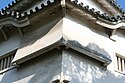
Angled chutes or "stone drib windows"
Himeji Castle contains advanced defensive systems from the feudal period.[seven] Loopholes ( 狭間 , sama ) in the shape of circles, triangles, squares, and rectangles are located throughout Himeji Castle, intended to allow defenders armed with tanegashima or archers to burn on attackers without exposing themselves.[8] Roughly i,000 loopholes exist in the castle buildings remaining today.[5] Angled chutes chosen "stone drib windows" ( 石落窓 , ishi-otoshi-mado ) were likewise set at numerous points in the castle walls, enabling stones or boiling oil to be poured on the heads of attackers passing by underneath, and white plaster was used in the castle'southward construction for its resistance to fire.[26]
The castle complex included three moats, 1 of which—the outer moat—is now buried.[6] Parts of the primal moat and all of the inner moats survive.[half-dozen] The moats have an average width of xx m (66 ft), a maximum width of 34.5 m (113 ft), and a depth of about 2.7 grand (8.9 ft).[9] The Three Country Moat ( 三国堀 , sangoku-bori ) is a ii,500 m2 (27,000 sq ft) pond which exists inside the castle; one of the purposes of this moat was to store water for apply in fire prevention.[5]
The castle complex, particularly the Waist Quarter ( 腰曲輪 , koshikuruwa ), contains numerous warehouses that were used to store rice, salt and water in case of a siege.[5] A building known equally the Table salt Turret ( 塩櫓 , shioyagura ) [fifteen] was used specifically to store salt, and it is estimated that it independent as many as 3,000 bags of salt when the castle complex was in use.[v] The castle complex as well contained 33 wells within the inner moat, 13 of which remain; the deepest of these has a depth of 30 thousand (98 ft).[5]

"Diamond Gate", the offset of the castle'south 21 remaining gates[5]
One of the castle'southward most of import defensive elements is the confusing maze of paths leading to the castle'southward keep.[8] The gates, baileys, and outer walls of the complex are organized then as to confuse an approaching forcefulness, causing it to travel in a spiral pattern around the complex on its way to the continue.[8] The castle complex originally contained 84 gates, 15 of which were named according to the Japanese syllabary iroha (I, Ro, Ha, Ni, Ho, He, To, etc.).[5] Now, 21 gates from the castle circuitous remain intact, 13 of which are named according to the Japanese syllabary.[v]
In many cases, the castle walkways even turn back on themselves, greatly inhibiting navigation.[26] For example, the direct altitude from the Hishi Gate ( 菱の門 , hishinomon ) [15] to the main keep ( 大天守 , daitenshu ) is simply 130 m (430 ft), merely the path itself is a much longer 325 thousand (1,066 ft).[5] The passages are also steep and narrow, farther inhibiting entry.[5] This system immune the intruders to be watched and fired upon from the keep during their lengthy arroyo, merely Himeji Castle was never attacked in this manner then the system remains untested.[7] [eight] However, even today with the route clearly marked, many visitors take trouble navigating the castle complex.
Cultural impact [edit]
Himeji Castle is frequently known every bit Hakuro-jō or Shirasagi-jō ("White Egret Castle" or "White Heron Castle") because of its vivid white outside and supposed resemblance to a bird taking flight.[half dozen] [eight] The castle has been featured extensively in foreign and Japanese films, including the James Bond motion-picture show "You Only Live Twice" (1967), and Akira Kurosawa's Kagemusha (1980) and Ran (1985).[xi] In the idiot box miniseries Shōgun (1980) information technology served as a stand up-in for feudal-era Osaka castle.[xvi] In the video games Civilization Revolution and Civilization V, Himeji Castle is available to build every bit a world wonder. Information technology is also to be found equally a Not bad Building in Forge of Empires.
Lore and legend [edit]

Himeji Castle is associated with a number of local legends.[5] The well-known kaidan (or Japanese ghost story) of Banchō Sarayashiki ( 番町皿屋敷 , "The Dish Mansion at Banchō" ) is gear up in Edo (Tokyo), but a variant chosen Banshū Sarayashiki ( 播州皿屋敷 , "The Dish mansion in Harima Province" ) is set in Himeji Castle. There is a disputed claim that the castle is the bona fide location of the entire legend, and the alleged Okiku'south Well remains in the castle to this mean solar day.[iv] According to the legend, Okiku was falsely accused of losing dishes that were valuable family treasures, so killed and thrown into the well.[five] Her ghost remained to haunt the well at night, counting dishes in a despondent tone.[5]
Himeji Castle is said to be inhabited by the yōkai Osakabehime, who lives in the castle tower and avoids humans, whom she hates.[27] In some legends she takes the form of an old adult female (or woman in her 30s) in ceremonial, twelve-layered kimono.[28] She can read human minds and command lesser animal-like yōkai, kenzokushin. [28]
The legend of the "Old Widow'south Stone" ( 姥が石 , Ubagaishi ) is another folklore story associated with the castle.[five] Co-ordinate to the legend, Toyotomi Hideyoshi ran out of stones when building the original three-story continue, and an former woman heard almost his trouble.[v] She gave him her hand millstone even though she needed it for her trade.[v] It was said that people who heard the story were inspired and also offered stones to Hideyoshi, speeding upwards structure of the castle.[5] To this day, the supposed rock can exist seen covered with a wire cyberspace in the middle of i of the stone walls in the castle circuitous.[5]
A sociology story is also associated with Sakurai Genbei, who was Ikeda Terumasa'south primary carpenter in the construction of the go along.[v] According to the legend, Sakurai was dissatisfied with his structure, feeling that the keep leaned a piddling to the southeast.[5] Somewhen, he became distraught and climbed to the peak of the keep, where he jumped to his death with a chisel in his mouth.[five]
Company statistics [edit]
- On xiv Apr 2009, the total number of visits since the Showa-era restoration surpassed 40 million.[29]
- 1964 – 1,738,000 (Showa-era restoration work completed)
- 1989 – 1,197,000
- 1990 – 811,000
- 1991 – 871,000
- 1992 – 885,000
- 1993 – 1,019,000
- 1994 – 983,000
- 1995 – 695,000
- 1996 – 861,000
- 1997 – 716,000
- 1998 – 792,000
- 1999 – 713,000
- 2000 – 662,000
- 2001 – 708,000
- 2002 – 729,000
- 2003 – 814,000
- 2004 – 771,000
- 2005 – 778,000
- 2006 – 899,000
- 2007 – i,023,000
- 2008 – ane,195,000
- 2009 – 1,561,000
- 2010 – 458,000 (restoration work started)
- 2011 – 611,000
- 2012 – 711,000
- 2013 – 881,000[30]
- 2014 – 919,000[thirty]
- 2015 – 2,860,000 (restoration piece of work completed in March)[31]
Boosted information [edit]

Keshō yagura (Dressing Belfry) attributed to Senhime as role of her private chambers
National treasures and sister castles [edit]
Other national treasures (castles) too Himeji Castle include Matsumoto Castle, Inuyama Castle, Matsue Castle, and Hikone Castle. The sister castles of Himeji Castle are Château de Chantilly in France and Conwy Castle in Wales,.[32] Castles that were of the aforementioned hirayama hilltop styles are Matsuyama Castle (Iyo) built in 1603 and Tsuyama Castle.
Matsumoto Castle [edit]
Matsumoto Castle (松本城 Matsumoto-jō) is one of Japan's oldest castles and is situated in Matsumoto, in Nagano Prefecture. The main donjon (天守閣 tenshukaku) was constructed by the Ishikawa family unit from 1593 to 1594 when the family was put in accuse of the castle. The donjon of Matsumoto Castle is one of Japan's oldest existing five stories Tenshu.
Inuyama Castle [edit]
Inuyama Castle (犬山城 Inuyama-jō) is located in the southern declension of Kiso river in the city of Inuyama, in Aichi Prefecture. In 1537, Oda Nobunaga's uncle, Oda Nobuyasu strengthened the castle. Inuyama Castle is claimed to be ane of Nihon's oldest castles and 1 of the castles that managed to retain its original structure.
Hikone Castle [edit]
Hikone Castle (彦根城 Hikone-jō) is located in the eastern coast of Lake Biwa, in Shiga Prefecture. The castle was completed in 1622 by Ii Naokatsu, after twenty years of construction.
Château de Chantilly [edit]
Château de Chantilly is a sis castle of Himeji Castle, and it is said to be the most beautiful castle in France. It is located 40 kilometres due north of Paris. The castle is a representation of the magnificent architectural style of the Renaissance catamenia. The partnership between Himeji Castle and Chantilly castle began in 1989.
Conwy Castle [edit]
Conwy Castle is a sis castle of Himeji Castle. The partnership betwixt Himeji Castle and Conwy Castle began in 2019.
Gallery [edit]
Panoramic overview

A panoramic view of the castle grounds, with Himeji city in the groundwork
Views from afar
-

The castle's keeps and city as seen from Engyō-ji
-

The castle complex as seen from the west
-

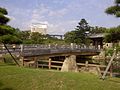
Keeps and bridge as seen from the entrance
-

A view of Keeps and the lush castle grounds below
-

Keeps as seen from the grounds beneath
Views from beneath
-

One of the steep, narrow walkways controlling access to the castle
-

One of the steep castle walls
-
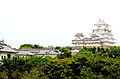
Himeji castle as seen from the princess quarters
-

The proceed as seen from within the inner circle ( 本丸 , honmaru )
-

Curved gables ( 千鳥破風 , chidori hafu )
-
-

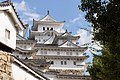
Detail of keep
-
Diverse external views with tourists, 2019
-
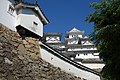
Himeji Castle view from below in May 2017
Views at night
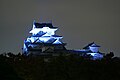

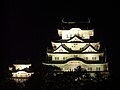
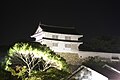

Views from above
-

Castle walls and rooftops
-

East belfry and corridors
-
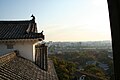
The castle rooftops and surrounding city
-

Part of the intricate castle complex
-

A mythical tiger-headed fish chosen shachi (鯱). This motif was used atop the castle towers as a talisman for burn down prevention.[8]
Views from the interior
-

A stone drop window ( 石落窓 , ishi-otoshi-mado )
-

An interior room with Tatami mats
-
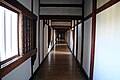
A hallway
-
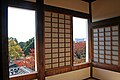
Castle windows
Views with cherry blossoms
-
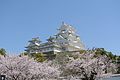
Taken at Three Country Moats
-
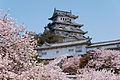
Sakura at Himeji Castle
-

Taken at Himeji City Zoo
-

Taken from the south
Views of the restoration
-
Temporary cover and gantry
-

Temporary comprehend
-

Different stages of applying plaster to the roof tiles. The plaster protects the roof from water ingress, and stops the tiles being dislodged by typhoon winds.
-

Roof structure underneath the tiles
-
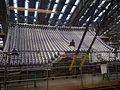
View of the keep roof nearing completion, taken from the public view gallery.
Views of pictures
-

-

-

A fish.
See as well [edit]
- Kōko-en, garden joining the castle circuitous
- Tsuyama Castle and Matsuyama Castle (Iyo), likewise built in the hirayama (平山城 flat hilltop castle) fashion
- List of National Treasures of Japan (castles)
- List of reportedly haunted locations
- List of Special Places of Scenic Beauty, Special Celebrated Sites and Special Natural Monuments
- Listing of Globe Heritage Sites in Japan
References [edit]
- ^ "Himeji Castle and its surroundings". Sansen-ya. Retrieved July six, 2010.
- ^ a b c d eastward f 1000 "Himeji Castle starts its renovation in April". Official Tourism Guide for Japan Travel. Archived from the original on March 24, 2011. Retrieved July 1, 2010.
- ^ a b c d e f m h i j k l k n o p q r "A hilltop white heron 400 years one-time". The Daily Yomiuri . Retrieved July 5, 2010.
- ^ a b c d eastward Jacqueline A., Ball (2005). Himeji Castle: Japan'due south Samurai Past. New York: Bearport Publishing. p. 32. ISBNi-59716-001-half dozen.
- ^ a b c d east f one thousand h i j m l m n o p q r s t u v westward x y z aa ab ac ad ae af ag ah ai aj ak al am an ao ap aq ar as at au av aw ax ay az ba bb bc bd be bf bg bh bi bj bk bl bm "National Treasure Himeji Castle Guide book" (PDF). Himeji Rojyo Lions Order. 2000. Archived from the original (PDF) on July 10, 2011. Retrieved July x, 2010.
- ^ a b c d e f Bornoff, Nicholas (2000). The National Geographic Traveler: Japan. Washington: National Geographic Society. pp. 256–257. ISBN0-7894-5545-5.
- ^ a b c d e f g "Himeji-jo". UNESCO World Heritage Centre. Retrieved July 4, 2010.
- ^ a b c d due east f g h Eyewitness Travel Guides: Japan. New York: Dorling Kindersley Publishing. 2000. pp. 200–203. ISBN0-7894-5545-5.
- ^ a b c d eastward "Himeji Castle". Japan Atlas. Retrieved July 5, 2010.
- ^ a b "Archived copy" 国宝一覧 (in Japanese). Himeji urban center. Archived from the original on September 27, 2010. Retrieved July v, 2010.
{{cite spider web}}: CS1 maint: archived copy every bit title (link) - ^ a b c "The Three Famous Castles of Nippon". Kobayashi Travel Service. Archived from the original on March 22, 2010. Retrieved July iv, 2010.
- ^ a b "Archived re-create". Archived from the original on Feb xv, 2015. Retrieved January 28, 2015.
{{cite spider web}}: CS1 maint: archived copy equally title (link) - ^ Hinago, Motoo (1986). Japanese Castles. Kodansha International Ltd. and Shibundo. pp. 121–125. ISBN0-87011-766-1.
- ^ a b c d O'Grady, Daniel. "Japanese Castle Explorer – Himeji Castle". Japanese Castle Explorer. Retrieved July 11, 2010.
- ^ a b c d "世界遺産姫路城 城の楽しみ方". Retrieved May eighteen, 2016.
- ^ a b Lowe, Sam (May eleven, 2010). "Restoring a Japanese Treasure". Best Western's Travel Blog. Archived from the original on May 24, 2010. Retrieved July eleven, 2010.
- ^ "姫路城大天守". Archived from the original on June 24, 2016. Retrieved May 18, 2016.
- ^ "National Treasure, World Heritage, Himeji Castle". Retrieved May 18, 2016.
- ^ "姫路城乾小天守". Retrieved May 18, 2016.
- ^ "姫路城西小天守". Archived from the original on June 24, 2016. Retrieved May 18, 2016.
- ^ "姫路城東小天守". Archived from the original on June 24, 2016. Retrieved May 18, 2016.
- ^ "姫路城イ・ロ・ハ・ニの渡櫓附台所1棟". Archived from the original on May eight, 2016. Retrieved May xviii, 2016.
- ^ "Kokoen Garden, Traditional Japanese Garden in Himeji City". EOK. Retrieved July 4, 2010.
- ^ 姫路市史第十四巻別編姫路城. Himeji City: City of Himeji. 2001. p. 494.
- ^ "Hoplology". Guillaume Morel. Retrieved July 11, 2010.
- ^ a b Turnbull, Stephen (2003). Japanese Castles 1540–1640. Oxford: Osprey Publishing. p. 64. ISBN978-one-84176-429-0.
- ^ Ishikawa, Ichirō; 石川一郎 (1989). Edo bungaku zokushin jiten (Shohan ed.). Tōkyō: Tōkyōdō Shuppan. p. 63. ISBN4-490-10255-0. OCLC 22591554.
- ^ a b Meyer, Mathew. "Osakabe hime". Yokai.com . Retrieved February 12, 2021.
{{cite web}}: CS1 maint: url-status (link) - ^ 姫路城、入場者4000万人突破 昭和の大修理から45年で Archived July 12, 2014, at the Wayback Machine(共同通信2009年4月14日)
- ^ a b "平成26年度姫路市入込客数、観光動向・イベントアンケート調査報告書 P3" (PDF). Archived from the original (PDF) on June 16, 2016. Retrieved May 18, 2016.
- ^ Yoshiko Yukinaga. "「姫路城来場者、日本一に。過去最多286万人」". Mainichi Shinbun. Retrieved May thirteen, 2016.
- ^ "姫路市|姉妹都市(海外・国内)/姉妹城". www.city.himeji.lg.jp/ (in Japanese). Retrieved November 14, 2021.
- Further reading
- Benesch, Oleg. "Castles and the Militarisation of Urban Society in Imperial Japan," Transactions of the Royal Historical Society, Vol. 28 (Dec. 2018), pp. 107-134.
- Benesch, Oleg and Ran Zwigenberg (2019). Japan's Castles: Citadels of Modernity in War and Peace. Cambridge: Cambridge University Printing. p. 375. ISBN9781108481946.
- De Lange, William (2021). An Encyclopedia of Japanese Castles. Groningen: Toyo Printing. pp. 600 pages. ISBN978-9492722300.
- Mitchelhill, Jennifer (2013). Castles of the Samurai:Power & Dazzler. Usa: Kodansha. ISBN978-1-56836-512-1.
- Schmorleitz, Morton S. (1974). Castles in Japan . Tokyo: Charles East. Tuttle Co. pp. 123–125. ISBN0-8048-1102-4.
- Motoo, Hinago (1986). Japanese Castles. Tokyo: Kodansha. ISBN0-87011-766-i.
External links [edit]
- Official website
- Japan'southward Samurai Castles
- Asian Historical Compages – Himeji Castle
- Japanese Castle Explorer – Himeji Castle
- UNESCO World Heritage Centre – Himeji Castle
- Nihon Atlas: Himeji Castle
- Video
- The White Fortress: Himeji-jo (UNESCO video at YouTube)
- Himeji Castle timelapse on YouTube
- Notice the Himeji Castle in Nihon
- Virtual bout of Himeji Castle examining its modern history on the Nippon's Modern Castles YouTube channel
Source: https://en.wikipedia.org/wiki/Himeji_Castle

Enregistrer un commentaire for "Castle Story Make Archers Into Workers Again"